


Supporting Healthy Vision as Your Child Grows
Myopia, or nearsightedness, is becoming increasingly common in children and often progresses as the eyes grow. While glasses and contact lenses can correct vision, they do not address how quickly the prescription may change over time.
At 20Twenty Eyecare, we take a proactive approach to myopia control by helping slow progression and support long-term eye health. Using a combination of diagnostics and personalized treatment options such as MiSight, Stellest lenses, and ortho-k, we design care plans tailored to each child’s vision needs and lifestyle.
If your child has been diagnosed with myopia, early intervention can make a meaningful difference in their long-term visual development. Contact us to schedule your consultation today.

What Is Myopia?
Myopia is a refractive error where distant objects appear blurry while near vision remains clear. It typically develops when the eye grows too long, or the cornea bends light incorrectly, causing images to focus in front of the retina instead of on it.
In children, myopia often progresses during growth years. While corrective lenses improve clarity, they do not slow the underlying progression without targeted treatment.
Signs of Myopia in Children
Children may not always realize they are having vision problems. Common signs of myopia include:
- Squinting or sitting very close to screens or books
- Frequent headaches
- Difficulty seeing the board at school
- Rubbing eyes often
- Complaints of tired eyes
- Difficulty focusing during reading or schoolwork
If you notice these signs, an eye exam can help determine whether myopia is present and whether treatment is recommended.

Why Myopia Control Matters
Controlling myopia is about more than clearer vision today; it’s about protecting long-term eye health. Higher levels of myopia are associated with increased risks of eye conditions later in life, including:
By slowing progression early, we aim to reduce these risks and help stabilize vision at a lower prescription over time.


Corneal Topography and Ongoing Monitoring
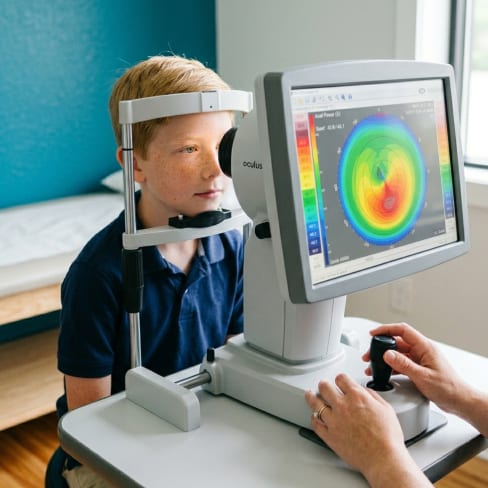
Corneal topography allows us to map the shape of the eye in detail, which is especially important for ortho-k fittings and specialty contact lens design. This process helps ensure accurate fitting and allows us to monitor changes over time.
Regular follow-up visits are an important part of myopia control, allowing us to track progression and adjust treatment as needed.
Our Myopia Management Options
There is no single approach to myopia control that works for every child. That is why we offer a range of evidence-based treatment options designed to slow progression in a way that fits your child’s eyes, lifestyle, and visual needs.
At 20Twenty Eyecare, we carefully evaluate how myopia is changing over time and build a personalized plan that may include one or more treatment methods. The goal is not only to improve day-to-day vision, but to help reduce long-term risks associated with high myopia.
MiSight 1 day lenses are soft, daily disposable contact lenses specifically designed for myopia control in children. They provide clear, comfortable vision throughout the day while also helping slow the progression of nearsightedness.
Because MiSight lenses are single-use, they are a convenient and hygienic option for active children and teens. Many families appreciate that this option combines vision correction with proactive long-term eye care in a simple daily routine.
Orthokeratology (ortho-k) and Corneal Refractive Therapy (CRT) are overnight contact lens treatments that gently reshape the surface of the cornea while your child sleeps. This allows for clear daytime vision without the need for glasses or contact lenses.
In addition to providing daytime freedom, ortho-k has been shown to help slow the progression of myopia in many children. This makes it a powerful option for families looking for both vision correction and long-term eye health support.
Specially designed spectacle lenses, including Essilor Stellest lenses, provide an effective option for children who prefer or need glasses. These lenses are engineered to provide clear central vision while also incorporating technology that helps slow myopia progression.
They are a simple, non-invasive option that can be worn throughout the day and easily incorporated into school, sports, and daily activities.
Low-dose atropine eye drops are one of the most widely used medical treatments for slowing myopia progression in children. These drops are used once daily at bedtime and work by helping reduce the rate at which the eye grows.
Treatment is carefully monitored through regular follow-ups so we can track changes in prescription, eye health, and overall response. Dosage or treatment plans may be adjusted over time to prioritize the best possible outcome for your child.
Multifocal contact lenses are designed with multiple focusing zones to reduce visual strain and support healthy visual development. These lenses can be used as part of a myopia control strategy to help slow progression in some children.
They are often a good option for children who are not yet ready for specialty lenses or who prefer a soft contact lens option for daily wear.
For children who have both myopia and astigmatism, multifocal toric contact lenses offer a customized solution. These lenses correct astigmatism while also providing myopia control support through specialized optical design.
This option allows for clear, stable vision while still addressing long-term changes in prescription.
For some children, the best results come from combining treatment methods. This may include low-dose atropine paired with contact lenses or spectacle-based myopia control options to enhance effectiveness.
Every myopia control plan is fully customized based on your child’s age, prescription, eye health, lifestyle, and how their eyes are responding over time. Regular monitoring allows us to make adjustments as needed to support the best possible long-term outcome.
Take a Proactive Approach to Your Child’s Vision
Myopia control is about understanding how your child’s eyes are changing as they grow. The earlier we understand what is happening, the more we can do to help slow progression and support their visual needs.
At 20Twenty Eyecare, we combine detailed testing with personalized treatment options, such as atropine eye drops, MiSight lenses, ortho-k, and specialty myopia-control glasses, to build a plan that fits your child’s eyes and lifestyle. Just as importantly, we track changes over time so care can be adjusted as needed for the best possible outcome.
If your child is showing signs of nearsightedness or has already been diagnosed, early action can make a meaningful difference in their visual future. Book a myopia control consultation today and take the next step in protecting their vision as they grow.
Frequently Asked Questions About Myopia Control
Myopia, or nearsightedness, is a condition where distant objects appear blurry while close objects remain clear. It usually develops during childhood as the eye grows and changes shape.
Myopia often continues to progress as children grow. Higher levels of myopia are linked to an increased risk of eye conditions later in life, including retinal detachment, glaucoma, cataracts, and myopic maculopathy. Slowing progression early can help reduce these risks.
Standard glasses and contact lenses improve vision but do not slow down how quickly myopia progresses. Myopia control treatments are specifically designed to help slow this progression over time.
At 20Twenty Eyecare, treatment options may include MiSight 1 day contact lenses, ortho-k, Stellest myopia control glasses, low-dose atropine eye drops, and specialty contact lenses such as multifocal or toric designs.
Ortho-k lenses are worn overnight to gently reshape the surface of the eye while your child sleeps. This allows for clear daytime vision without glasses or contacts and may also help slow myopia progression.
MiSight 1 day lenses are soft daily disposable contact lenses designed specifically for children with myopia. They provide clear vision while also helping to slow the progression of nearsightedness.
Low-dose atropine eye drops are commonly used in myopia management and are generally well tolerated. Treatment is carefully monitored and adjusted based on your child’s response and eye health.
Treatment is based on your child’s age, prescription, eye health, lifestyle, and how quickly their myopia is progressing. In some cases, combination treatments may provide the best results.
Myopia cannot be reversed, but its progression can often be slowed with the right treatment plan. The goal is to reduce how quickly the prescription changes over time.
Most children in a myopia control program are seen regularly for follow-up visits so we can track changes, adjust treatment if needed, and monitor overall eye health.

Explore Our Eyewear Brands








Come Visit Us in Bozeman
Our Address
Contact Information
- Phone: 406-522-8888
- Fax: 406-404-1885
- Email: info@20twentymt.com
Hours of Operation

What People Are Saying
Testimonials
I had a great experience at 20twenty eyecare from start to finish. Dr. Blom and Cora were friendly, knowledgeable, and great to work with. Cora was fantastic when helping me pick out and fit my frames. She picked out frames that would best suit my face and made sure everything fit comfortably. I’m really happy with my experience and would definitely recommend them to anyone!
Bailey
I was very well taken care of at 20Twenty. Dr Blom and the staff were great. I felt the exam was very thorough and not rushed. Dr Blom spent a lot of time with me and was very good at explaining my tests. I would highly recommend him. He has also taken excellent care of my daughter. Much appreciated.
Wally
What a kind and professional staff! I felt heard and allowed to ask questions. The office was very clean and with today’s health concerns, that is important. My Dr. was thorough and I felt well taken care of. I was grateful that my annual vision health was taken seriously with Professionalism. A patient of 4 years.
April
20Twenty Eyecare is the very best that I have experienced anywhere. All of the staff, from the front desk to the examining rooms and the opticians are very professional, extremely knowledgeable, and always willing to explain what they are doing and answer questions. They are always very thorough and get it right the first time. Thank you for a very pleasant experience each time that I visit.
Gloyd

